



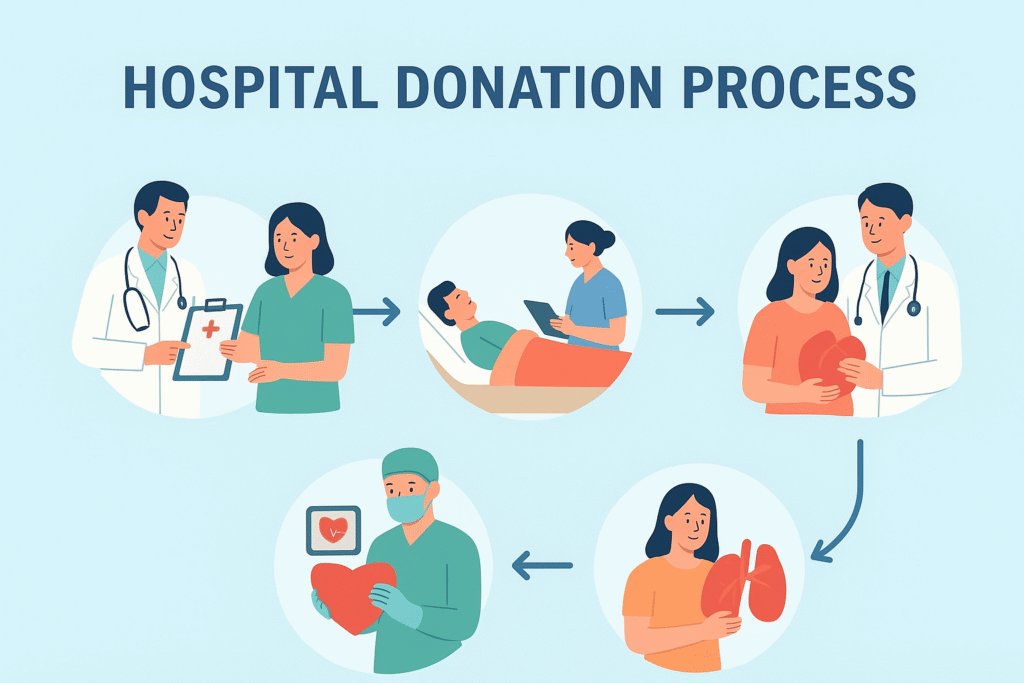
The hospital donation process plays a pivotal role in saving lives by ensuring effective organ matching, ethical standards, and coordinated action. Explore how supporting the funding support for organ donation programs can expand this life-saving system. More resources mean more families receive guidance during difficult moments, more hospitals can operate with trained specialists, and more donated organs reach patients in time.
To Pledge My Organs is simply a way to make sure the opportunity to save lives is not lost.
Table of Contents
What is the hospital donation process?
The journey of donating organs in a medical setting begins the moment a patient is identified as someone who might be able to help others through donation. From that point onward, a series of careful steps take place. Doctors first evaluate whether donation is medically possible and safe. After this, consent is confirmed through the family or the individual’s prior registration. Specialists then determine which recipients are the best match based on medical urgency and compatibility. Finally, transplant surgeries are conducted, followed by continued monitoring to ensure the organs function properly in the recipients.
Although this entire system is complex, the meaning behind it is deeply human. It gives families the chance to find purpose in heartbreak, and it offers people on waiting lists the possibility of a healthier future. It is designed to honor personal choice, protect dignity, and follow strict ethical rules.
Why it matters so much
When everything is coordinated smoothly, the donation system creates real change:
- The wishes of the person who wanted to help others are respected.
- Vital organs are transported on time and in excellent condition.
- People who would otherwise lose their lives get a new chance at living.
- Trust grows between the public and the medical community.
- Fairness remains at the heart of the decision-making process, ensuring that help reaches those who need it most.
What is the role of funding support for organ donation programs in practice?
- Public awareness and education
Financial support allows hospitals and donation networks to organize awareness campaigns that reach communities, schools, workplaces and social groups. Many people are willing to donate but are unsure how it works or feel influenced by myths. Education helps individuals understand the impact of donation and encourages informed decisions long before a crisis ever occurs. - Training for medical teams and coordinators
Donation involves sensitive conversations with grieving families, complicated logistics and precise communication between departments. Funding makes it possible to train coordinators, nurses and transplant specialists so they can manage timing, documentation, communication and emotional support in a respectful and well-organized way. - Transportation and organ preservation systems
Once an organ is approved for donation, timing becomes critical. Financial support ensures that the technology and teams responsible for preserving and transporting organs are available around the clock. This includes specialized containers, monitoring tools, transport drivers, rapid-response communication and access to aircraft or ambulances when needed.
Pro Tips
- Learn how the hospital donation process works
Take time to understand registration of donors, hospital coordination, compatibility checks, organ matching, transport to transplant surgery, and recipient follow-up. Being familiar with each step helps you explain it to others and encourages more people to become donors. - Support funding support for organ donation programs
Contribute financially or by volunteering to campaigns and initiatives that spread awareness, train medical teams and strengthen logistical systems. Your support helps ensure that resources are available exactly when they are needed most, improving timing and efficiency in life-saving situations. - Register your decision and inform your family
Deciding to donate is important, but making sure your family knows your wishes is equally essential. Loved ones are often involved in giving final consent, and clear communication in advance helps them feel confident and at peace when making that decision on your behalf. - Advocate within your community
Join or organise local drives, talk about donation in schools or workplaces, and share helpful information through events, meetings or community groups. You can also distribute printed materials or digital resources that explain how donation works and why public support matters. - Ask questions when you visit hospitals
If you or someone close to you faces a serious medical situation, don’t hesitate to ask healthcare professionals whether organ donation is discussed and how the procedure is coordinated. Understanding how the system works inside a hospital builds awareness and empowers people to make informed choices when it matters most. - Promote transparency and trust
People are far more open to donation when they know funds are used responsibly, staff are well trained and allocation is handled fairly. When transparency is prioritised, confidence grows, and more families feel comfortable supporting donation when the opportunity arises. - Stay updated on policy and medical advances
Donation practices continue to develop over time. New consent models, better preservation technology and improved protocols can all increase success rates. Staying informed helps you support meaningful changes and advocate for stronger medical systems and wider access to resources. - Match your actions with your intention
If you decide to become a donor, keep your information up to date and communicate with your family so they understand your wishes clearly. Having everything in place ensures the donation process can move quickly and respectfully if the need arises. - Encourage donor-family support systems
Families navigating donation decisions are often dealing with intense emotions and difficult circumstances. Counselling, community support and clear communication help reduce confusion and stress, allowing them to honor their loved one with confidence and peace of mind. - Celebrate success stories
Sharing real examples of people whose lives were transformed through donation inspires positive conversations and helps others see the human impact. Stories of recovery and renewed hope remind communities that donation is not just a medical procedure but a powerful gift.
FAQ
Q1: What does the hospital donation process involve?
This involves identifying a suitable donor, obtaining family consent, retrieving organs safely, matching those organs with patients on waiting lists, and arranging transplant surgery. It also includes follow-up care for recipients and support for donor families. Because of its complexity, the process relies on well-trained medical teams and strong organisational systems.
Q2: How many people can one donor help through donation programs?
Although the exact number varies, one donor can often help several recipients because multiple organs and tissues may be suitable for transplant. With strong support systems and funding support for organ donation programs, more of these opportunities can be realised rather than missed.
Q3: What if I pledge to donate but my family objects?
Even if someone has registered their decision, many regions still require approval from family members. For that reason, having an open and honest discussion with loved ones ahead of time is crucial. Clear communication helps families make decisions confidently during emotional moments.
Q4: Does age or illness automatically rule me out from being a donor?
Not necessarily. Eligibility depends on medical circumstances at the time donation becomes possible. Older individuals or those with certain conditions may still be able to donate specific organs or tissues, depending on medical assessments.
Q5: Why are public awareness and financial support for donation programs so important?
Donation relies on many interconnected systems working efficiently, such as trained staff, timely coordination, transportation and accurate communication. Without adequate resources, many potential donors are never reached and organs that could save lives may go unused. Supporting these programs strengthens the entire donation ecosystem and increases the chances of successful transplants.
Conclusion
The hospital donation process is a life-changing system that transforms generosity into real hope. With solid funding support for organ donation programs, that system becomes reliable, trust-worthy and efficient. By educating yourself, talking with family, supporting awareness, and pledging your organs via Pledge My Organs, you become part of the chain that makes saving lives possible.
To Pledge My Organs is simply a way to make sure the opportunity to save lives is not lost.
